
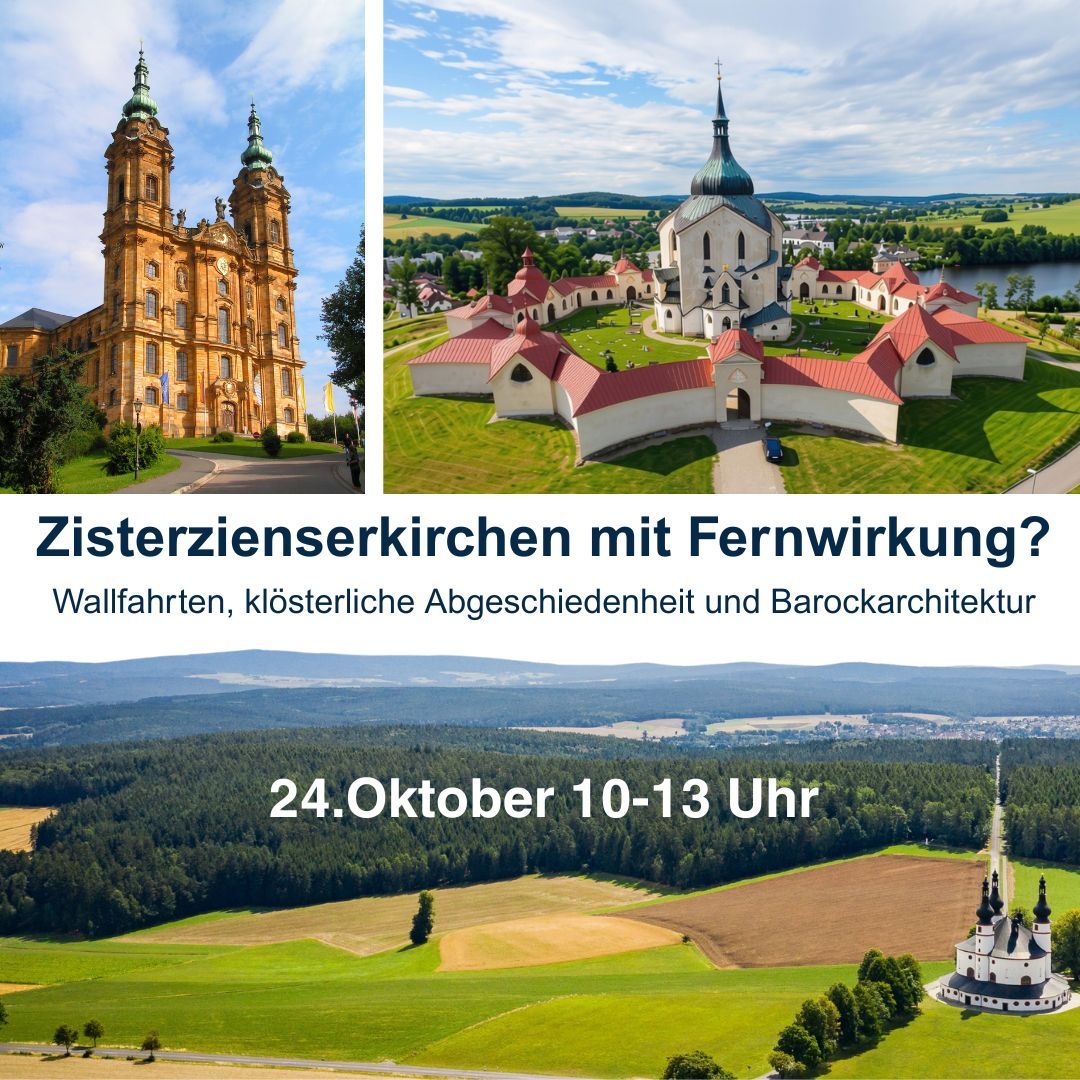
Cistercian Churches with a Far-Reaching Impact?! Pilgrimages, Monastic Seclusion, and Baroque Architecture
24. October um 10:00 - 13:00
Cistercian churches with a dramatic visual impact?!
Don’t they lie there, modest and without towers, in a lonely valley? How do monastic seclusion and the surging waters even go together?
In fact, pilgrimage churches and their associated networks of paths are an integral part of our historically developed Cistercian landscapes. It is not uncommon today for pilgrimage churches to outshine the monasteries to which they once belonged. Vierzehnheiligen is a good example of this. What pilgrim would know right away that it belonged to Langheim?
When one considers such structures visible from afar—such as the Kappel near Waldsassen, the green hill near Zdar nad Sazavou, or Maria Teinitz near Plasy—it quickly becomes clear that we are dealing with an entirely different genre of Cistercian architecture than that found in the monastery complexes themselves. Star architects such as Neumann, the Dientzenhofers, and Santini created here landmarks of faith visible from afar in the true pinnacle of Baroque architecture: the central-plan building.
Prof. Dr. Günter Dippold (Regional Heritage Officer for Upper Franconia), Christian Malzer, and Dr. Rosa Karl provide insight into the phenomenon of pilgrimage within the context of Cistercian cultural landscapes. The Burgwindheim district castle, formerly a farmstead, serves as an ideal venue. The Blood Pilgrimage in Burgwindheim was added to the list of Bavaria’s Intangible Cultural Heritage in 2026.
To wrap up the event, after enjoying some onion tart and Franconian grapes, we’ll join Sigrun Philipp on a walking tour of the town to the Chapel of the Holy Blood.
The Ebrach Monastery Complex is organizing this free training session. It will be held in person and in German.
Please register at cisterscapes@lra-ba.bayern.de – please indicate whether you would like to participate in the walking tour and register by October 22, 2016, if possible